
Most Texas families we work with know long-term care is a real risk. They also feel stuck between two unappealing choices: buy an expensive traditional long-term care policy they may never use, or simply “self-fund and hope for the best.”
Neither extreme serves most families well. The better path starts with clear numbers, honest family conversations, and a plan that integrates with the rest of your financial life — not a product sold in isolation.
The Reality of Long-Term Care Costs in Texas
Someone turning 65 today has roughly a 70% chance of needing some form of long-term care during their remaining lifetime. Not everyone will need years of skilled nursing. Many will need help with daily activities for a period of time — often at home first.
Source: U.S. Department of Health and Human Services, Office of the Assistant Secretary for Planning and Evaluation (ASPE), “What Is the Lifetime Risk of Needing and Receiving Long-Term Services and Supports?”
In Texas, 2026 median long-term care costs look roughly like this:
- Home care (substantial weekly hours): $4,500 – $5,700+ per month
- Assisted living: $4,000 – $5,700 per month
- Nursing home (semi-private): typically $5,600 – $8,000+ per month depending on location and level of care
Source: CareScout Cost of Care Survey 2025 (statewide medians). Actual costs vary by location and level of care.
These figures continue to rise faster than general inflation. A multi-year care need can easily reach several hundred thousand dollars — enough to meaningfully change the trajectory of a retirement or a family legacy.
More than 50 million Americans currently provide care to an adult age 50 or older. In farm and ranch families across the Texas Panhandle, the expectation that “we take care of our own” is especially strong — until the care becomes intense, continuous, or one spouse is left managing everything alone.
Source: AARP & National Alliance for Caregiving, Caregiving in the U.S. 2025 (51.3 million caregivers of adults age 50+).
Why “We’ll Just Self-Fund” Often Falls Short
Self-funding long-term care works for some high-net-worth families who deliberately set aside a conservative bucket and stress-test their portfolio for a multi-year care event. For many others it creates quiet risk:
- Sequence-of-returns pressure if care coincides with a market downturn
- Accelerated depletion of the assets meant to support a surviving spouse
- Family members stepping into caregiving roles that strain relationships, careers, and health
- Limited options later if health declines and insurance is no longer available
Self-funding is a legitimate strategy. It simply needs to be intentional rather than a default assumption.
Three Practical Long-Term Care Funding Paths
There is no single right answer for every Texas family. The best approach depends on health, assets, family dynamics, and what you value most — maximum pure care coverage, premium certainty, or legacy if care is never needed.
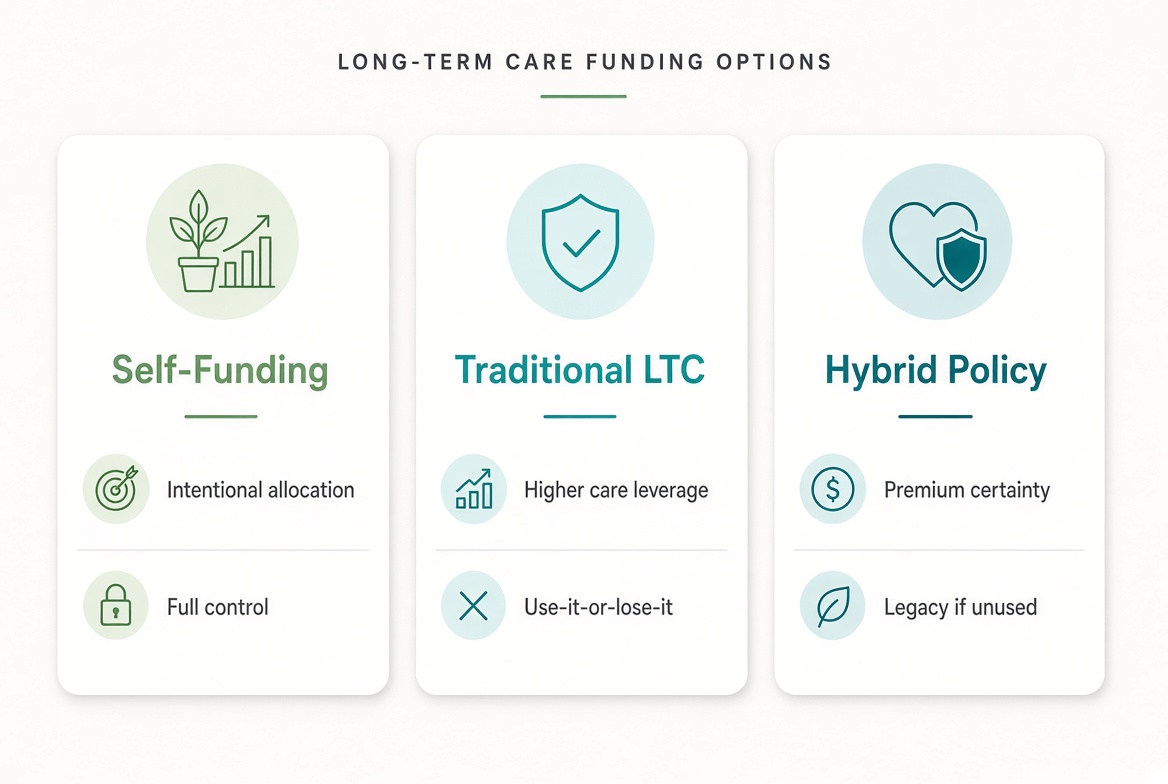
Three common approaches — each with different strengths depending on your priorities.
Dedicate a portion of the portfolio (often more conservative) specifically for potential long-term care costs. Model the impact on retirement cash flow and the surviving spouse. Pair it with clear family agreements about who will help and under what conditions.
Generally delivers more pure care benefit per premium dollar. Highly customizable (benefit amount, elimination period, inflation protection, shared care for couples). The trade-off: premiums can increase over time, and if you never need care the premiums are typically gone (use-it-or-lose-it).
Combine life insurance (or an annuity) with long-term care benefits. Premiums are usually guaranteed and often paid over a limited period or as a single premium. If care is never needed, a death benefit remains for heirs. These policies often appeal to families who dislike the idea of “wasted” premiums and who already value estate planning.
Many Texas families end up with a combination — a hybrid policy as a foundation plus intentional self-funding capacity for flexibility or longer care durations.
How Long-Term Care Fits Inside the Compass 7 Pillars

Risk Management is not isolated — it protects independence, dignity, and the legacy you intend to leave.
At Shoreline Planning Partners we treat long-term care as part of the Risk Management pillar of the Compass 7 Pillars — never as a standalone product decision. A complete conversation also examines:
- Cash Flow — Can the premiums (or the self-funded allocation) be sustained without crowding out other goals?
- Estate Planning Strategies — How does a care event interact with Medicaid look-back rules, estate recovery, and the desire to leave a clean legacy?
- Wealth Management — What does a multi-year care cost do to the portfolio’s ability to support the surviving spouse and the next generation?
- Family dynamics — Who will actually provide care, and how do we protect both the care recipient and the caregivers?
When these pieces are coordinated, families stop feeling stuck between two imperfect extremes and start building a long-term care plan that actually fits their lives in the Texas Panhandle.
Questions Worth Answering Together
- How much of a long-term care event could your current portfolio absorb without derailing the surviving spouse’s security?
- Do you prefer maximizing pure care coverage dollars, or certainty that something of value remains for heirs if care is never needed?
- How realistic is family caregiving in your specific situation — health of potential caregivers, geographic proximity, and other responsibilities?
- What is your comfort level with future premium increases versus paying more upfront for guarantees?
- Have you modeled the tax and estate implications of different long-term care funding approaches?
Long-term care planning should reduce uncertainty, not add another product decision.
If you would like to walk through the numbers and options that actually fit your Texas family, we are ready when you are.
Reach out. Let’s have a clear, practical conversation about risk management that protects both your independence and your legacy.
Shoreline Planning Partners, LLC — Serving the Texas Panhandle with guidance grounded in the Compass 7 Pillars.